Information systems are designed to process data, and DTO (Data Transfer Object) is an important concept in modern development. In the “classical” sense, DTOs are simple objects (without logic) that describe data structures that are transferred “over the network” between remote processes. If data is transferred between application layers within the same process, then such DTOs are called local DTOs.
The key objectives of a DTO are:
- data structuring: making it easier for the application developers to work with;
- data transformation: transform the data from the format used for transfer (e.g. JSON, XML, YAML) into the internal format used by the application (e.g. JavaScript Object);
Here, I will outline the principles I follow when building DTOs in my JavaScript applications.
Simple DTO
In a simple case, the DTO is a flat structure where each attribute is a primitive data type, such as a string or integer:
class Simple {
  aBool;
  aNumber;
  aString;
}
That provides structure. To transform data, the DTO accepts input and casts its values:
class Simple {
  constructor(data) {
    this.aBool = Boolean(data?.aBool);
    this.aNumber = Number.parseFloat(data?.aNumber);
    this.aString = String(data?.aString);
  }
}
Complex DTO
A complex DTO consists of other DTOs and primitive values:
class Complex {
  constructor(data) {
    this.aDto = new Simple(data?.aDto);
    this.aString = String(data?.aString);
  }
}
JSON-to-DTO transformation then looks like this:
const dto = new Complex({
  aDto: {aBool: true, aNumber: 16, aString: 'simple'},
  aString: 'complex',
});
Waterfall Type Casting
For waterfall casting of types in complex objects, connect the code sources with import and export. These are separate modules:
// simple.mjs
export default class Simple1 {}
// complex.mjs
import Simple from './simple.mjs';
export default class Complex {}
This lets us create deeply nested DTOs and modify individual components. At each level, the component parses its input fragment, casts data types, and connects constructors for nested levels.
Cutting vs. Casting
Suppose input JSON contains name, age, and weight, while a Person
DTO handles only the first two properties. We can cut unknown properties:
this.name = String(data?.name);
this.age = Number.parseInt(data?.age);
Or copy everything and cast the known properties:
Object.assign(this, data);
this.name = String(data?.name);
this.age = Number.parseInt(data?.age);
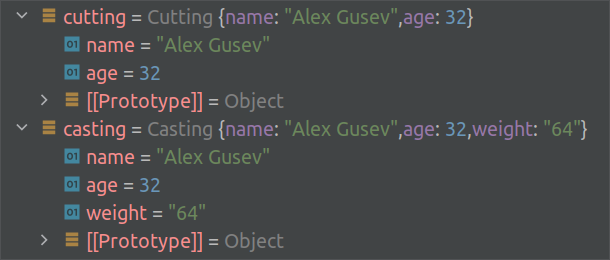
If our code is the final DTO handler, it is better to eliminate unnecessary data. An intermediate handler can cast the types it uses and leave unfamiliar data unchanged.
Resume
- DTO is a simple object that describes the data structure being transferred between remote processes or application layers.
- The main goals of a DTO are data organization and type casting.
- DTOs can have nested structures, making them capable of forming complex structures.
- In input data conversion to a DTO, data can either be cut off or have its types casted for known properties.