With the recent surge of interest in the social network Telegram, spurred by the arrest of its founder Pavel Durov in France, I decided to dive deeper into the technology of Telegram bots. In this post, I’ll explain this technology in simple terms, without getting too technical.
Telegram is a Messenger
First and foremost, Telegram is a messenger app, similar to WhatsApp, Skype, WeChat, and Viber. Through Telegram, you can exchange text messages, send files, make voice calls, and have video chats.
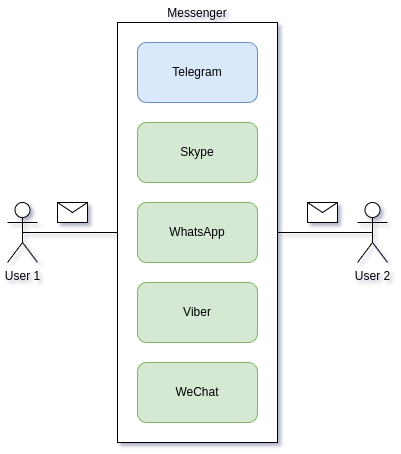
Telegram is a messenger
Telegram offers client applications for major operating systems.
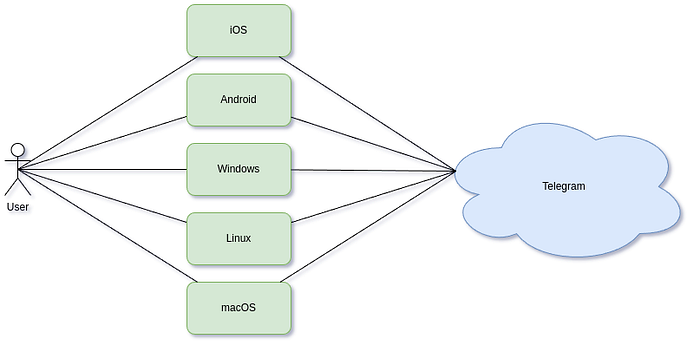
Operating systems supported by Telegram
The primary device for running the client app is a smartphone. You need a smartphone and a phone number to register on Telegram.
Telegram client for iPhone
After registration, you can download the Telegram client on your laptop or desktop and synchronize messages between devices (smartphone and laptop).
Telegram client for Linux desktop
The main purpose of Telegram is to transmit text and media messages to the user’s smartphone.
Why is Telegram Considered a Social Network?
In Telegram, every user can create their own groups and channels. In a group, users can communicate with each other, while in a channel, messages are sent from the channel administrators to the subscribers.
In both groups and channels, users can react to messages with likes. In channels, subscribers can also leave comments under the messages.
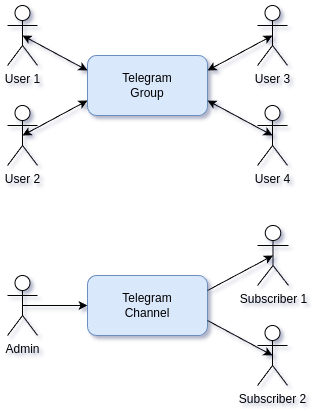
Group vs Channel
This way, Telegram allows the creation of communities united by common interests and the dissemination of information within these communities.
What Kind of Information Does Telegram Transmit?
The primary type of information is text messages. Telegram can also transmit media information: voice messages, photo and video files, and regular files. With Telegram, you can organize audio and video calls and screen sharing. You can also create polls and share your location.
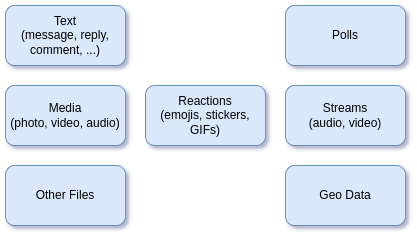
Info types
Reactions play a special role in Telegram — simple and animated emojis, stickers, and GIFs. You can even create your own reaction packs and share them with friends and acquaintances.
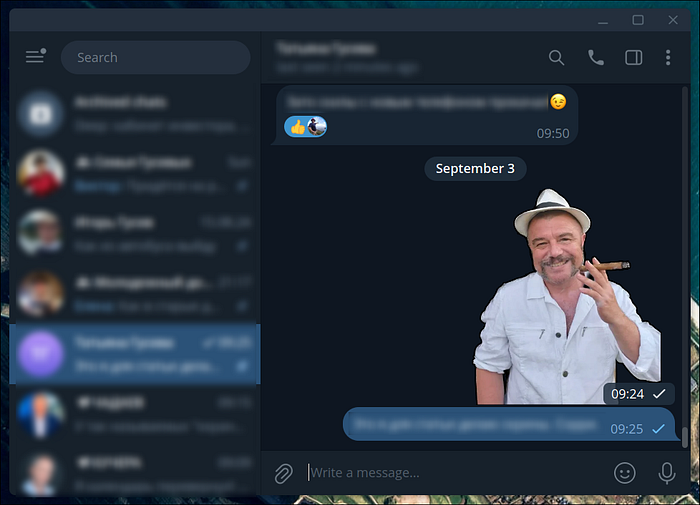
A family sticker
How Secure is Telegram?
From a technical standpoint, there is only one type of communication in Telegram that ensures relative data security — secret chats. In this mode, asymmetric keys are used to encrypt the transmitted data, and even Telegram cannot control the correspondence between two users (at least, that’s what they claim).

The secret chat
In all other cases, Telegram’s owners have the technical capability to monitor the information transmitted through their servers.
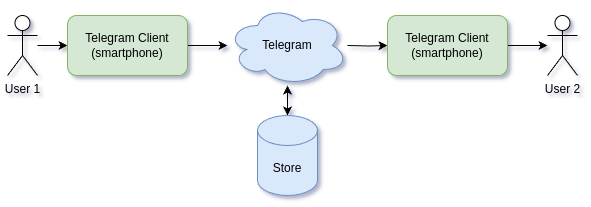
Other communication
Therefore, the security of transmitted data largely depends on the stance of Telegram’s management. So far, they position themselves as advocates of free speech and try to minimize contact with any government agencies.
What is a Bot?
A Telegram bot is a program hosted on external servers that have access to the Telegram API for communication with users. The bot interacts with users through the Telegram gateway — receiving and sending information from users. From the user’s perspective, interacting with a bot is similar to interacting with other users through the Telegram client.
Users and bots can exchange various types of information — text, media, and simple files, reactions, and geo-tags. You can think of a bot as an external extension that adds various enhancements to the basic functions of Telegram.
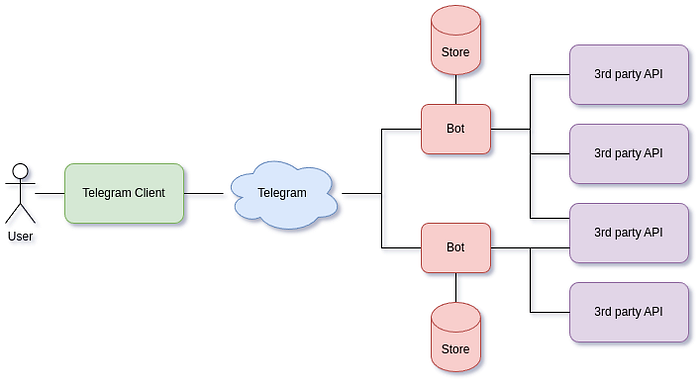
The bots extend base functionality
Bots can connect users to various external information systems and allow users to manage these systems through the Telegram app on their smartphone using text messages.
If we consider the concept of Web 3.0 (Semantic Web) as the interaction of programs (bots) through machine-readable protocols (e.g., REST JSON), then a Telegram bot can be seen as a point of human connection to this web. The means of connection is the Telegram client, and the interaction between humans and other bots in the semantic web occurs through the Telegram client interface (text, voice, files, streams).
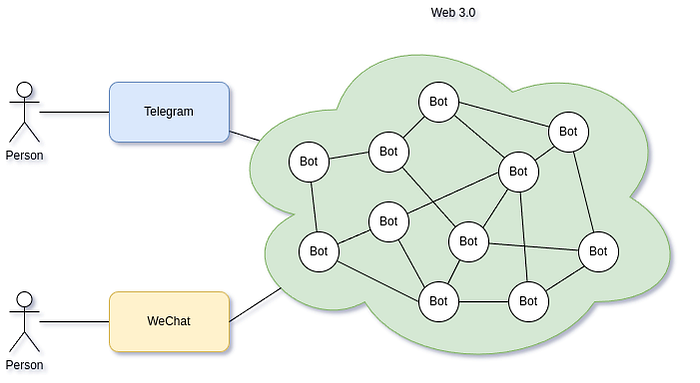
Connecting to Web 3.0
You could say that a browser is a means of integrating humans and Web 2.0, while clients like Telegram (e.g., WeChat) are a means of integrating humans and Web 3.0. Compared to a browser, such clients have limited functionality, but the platforms themselves offer simpler ways to integrate additional functionality through bots.
Payments
A powerful driver of platform development is the ability to make payments directly from the Telegram client. Telegram collaborates with numerous payment service providers (depending on the country of the seller and buyer) such as Stripe, Payme, YooMoney, and more.
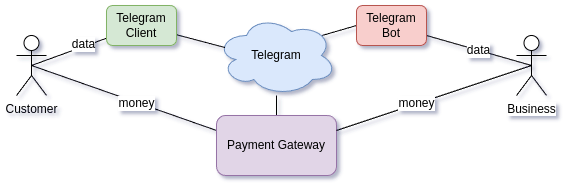
Payments
The platform not only provides additional services to Telegram clients but also allows for payment for these services. For small businesses, this can be a game-changer due to the ease of integration and the transformation of Telegram into a full-fledged platform for commercial and service offerings.
Conclusion
Telegram is a comprehensive platform that connects users to the capabilities of the Semantic Web (Web 3.0) alongside traditional browsers. Bots act as adapters for this platform to various nodes of Web 3.0, significantly expanding Telegram’s capabilities beyond simple messaging by integrating with external systems and providing diverse services directly from the chat interface.
The simplicity of integrating payment systems and extending functionality with bots positions Telegram as a key player in the future of digital communication and online transactions. This evolution not only enhances the user experience but also opens new opportunities for businesses and developers in an ever-expanding digital ecosystem.
If you enjoyed this article, please give it a clap and follow me for more content!
Stay connected:
Thank you for your support!