---
title: "Personal Web Apps"
description: "Before the advent of the web, all applications were personal and stored their data on the user’s computer. With the rise of the web, user data moved to corporate servers and privac"
date: 2024-03-24
---
Before the advent of the web, all applications were personal and stored
their data on the user’s computer. With the rise of the web, user data
moved to corporate servers and privacy was suddenly reduced. But what if
all personal data in web applications were exclusively stored on users’
devices, such as smartphones? In this article, I ponder what such
personal web applications could be like.
## What distinguishes web applications from native ones?
The two main differences, in my opinion:
- web applications run in the browser
- a server is needed to distribute web applications
At the moment, the browser is a kind of operating system for web
applications. Operating systems have their [own
API](https://en.wikipedia.org/wiki/DOS_API), and the browser also has
its own — [Web API](https://developer.mozilla.org/en-US/docs/Web/API).
Operating systems appeared as “*intermediaries*” between programs and
various hardware from different manufacturers. Browsers have also gone a
long way in standardizing the rules of programs within the browser and
with available peripherals (screen, keyboard, mouse, printer, etc.).
Unlike regular OS, the capabilities of low-level interaction of the
program with peripherals inside the browser are very limited. But for
the interaction of the program with a person, a device and other
programs, these functions are enough.
Applications used to be distributed on floppy disks and CDs, but with
the advent of broadband Internet, this method of installing programs on
personal computers has become irrelevant. Now most programs are
distributed through the web. But for a web application to end up in a
browser, a web server is still needed. Browser restrictions do not allow
you to run a full-fledged web application just by downloading code from
a disk or flash drive.
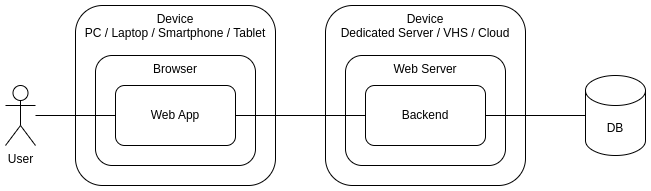
Thus, the scheme of the usual web application can be represented as
follows:
The regular web app
The application code is located on the user’s device (for example, a
smartphone) and on the server. The user’s main data is also stored on
the server along with the data of other users.
## Personal data storage
Approximately starting from 2015, browsers have been able to save and
process large volumes of data on the client side —
[IndexedDB](https://en.wikipedia.org/wiki/Indexed_Database_API). The
total size of the data depends on the volume of disk space of the local
device and on the browser in which the web application is running, and
can be measured in tens and hundreds of gigabytes.
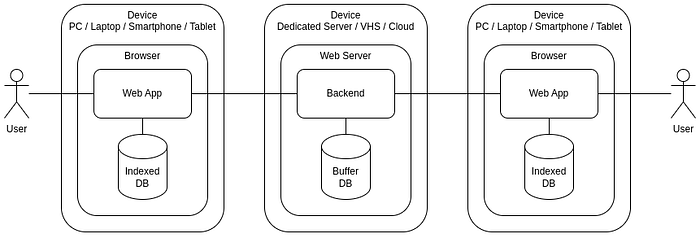
Thus, now you can create applications that save all the user’s personal
information on his own device (computer or smartphone):
The personal web app
Some client data is still on the server (for example, authentication),
but most of the personal data can now be stored centrally, using the
hardware capabilities of the user himself. Just imagine how much
performance requirements for central servers would decrease if the
processing of users’ personal data were transferred to their own
devices!
## The role of the server
In the new architecture of personal web applications, the server still
has the responsibility to distribute the application code — because the
browser still cannot load code from a flash drive or disk. If each user
stores his own personal data, then the server must also transmit this
data from one user to another if necessary.
If users are always online, then there are no problems with the
transfer. But if the recipient of the message is offline, then the
sender’s data will have to lie on the server for a while. Until the
recipient goes online and retrieves this data from the server.
All this is very similar to how regular email
([POP3](https://en.wikipedia.org/wiki/Post_Office_Protocol) protocol)
worked before Gmail appeared (a web interface to your mail on the
server).
## WebRTC
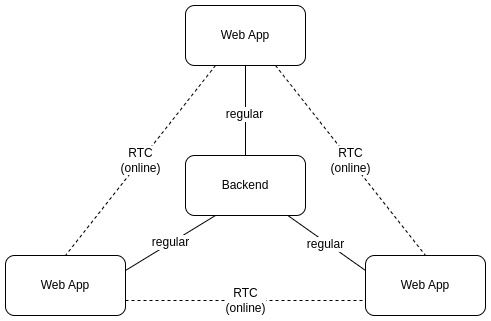
If two users are online at the same time, the server can be excluded
from the data transfer chain. With the help of
[WebRTC](https://webrtc.org/?hl=en) technology, data can be transmitted
directly between users. The server is only needed to establish initial
contact between users.
If personal data is transferred directly between users, then all network
traffic that previously passed through the server is spread between
individual pairs of users. This can significantly reduce network load on
the server.
If asymmetric encryption of each “user — user” connection is used in
such a decentralized environment, then the server can also remove the
user authentication function. Users exchange public keys when
establishing contact, and then use these keys to encrypt and verify
messages.
These keys can also be used for forwarding messages when the recipient
is offline and messages are temporarily buffered on the server. Without
encryption keys, the server cannot access user data.
## Clouds/Pods
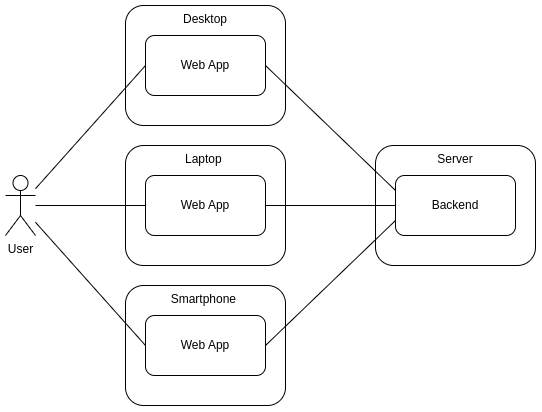
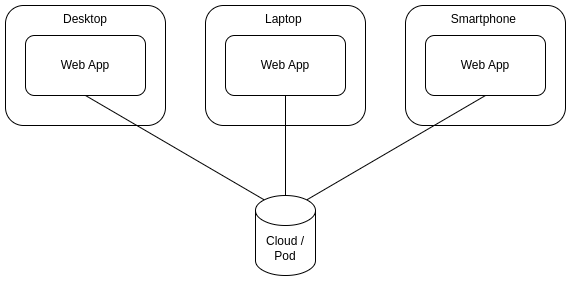
If user data is stored on the user’s device, not on the server, then
there is a situation where the user has several instances of some
application on different devices (for example, on a laptop and
smartphone):
The user has multiple devices with the same app
It is clear that when each device has its own personal database for
storing user’s personal data, some replication mechanism is needed. That
is, the user must have his own personal server through which he could
replicate his data between different devices.
Replicate the data with Cloud/Pod
Similar services are already offered by cloud data storage (Dropbox,
Google Drive, OneDrive, etc.) and similar technologies (for example,
[Solid](https://solidproject.org/about)). In the simplest case, when the
user has only one device with a personal application, external storage
serves as a backup data storage in case of device loss.
## Conclusion
The demand for confidentiality of personal data and the development of
web applications create conditions for the emergence of personal web
applications in which user data is stored not on the central servers of
corporations, but on the user’s devices themselves and are replicated
between devices through external storage, which are also managed by the
user.
I consider this direction of development of web technologies promising
and try to conduct the development of my web applications precisely in
this key. If you need to develop such web applications, I would be
interested in joining such a project to the best of my abilities to pump
up my own skills in this direction.
If you enjoyed this article, please give it a clap and follow me for
more content!
Stay connected:
- [GitHub](https://github.com/flancer64)
- [LinkedIn](https://www.linkedin.com/in/aleksandrs-gusevs-011ba928/)
- [Upwork](https://www.upwork.com/freelancers/~0181de0a64c6981497)
Thank you for your support!
Personal storage, profiles, and the relationship between devices are
part of the broader browser model described in [Browser as an Operating
System for Developing Modern
Applications](/en/books/browser-as-operating-system.html).